Showing posts with label Michael LaFosse. Show all posts

Saturday, 31 May 2008

Horseshoe Crab


(Click to enlare image)


Of all the techniques that have become part and parcel of modern origami, Wet Folding must be the most indispensable. This involves dampening the paper slightly before making the creases. The added moisture temporarily dissolves the sizing (the water-soluble adhesive that holds the paper together) allowing the fibres to be shifted and then set in a slightly different position. In essence you are manipulating both the shape of the paper and its underlying physical structure. This enables folders to sculpt the material, creating softer, longer-lasting creases and curves, which add an element of realism to models.

Wet folding was the brainchild of Akira Yoshizawa - the father of modern Origami, whose goal was to create lifelike, three-dimensional animals and plants. One of the first western folders to embrace the technique was Michael LaFosse.

This Horseshoe Crab, designed by LaFosse, is eight inches long. Evidence of wet folding can be seen in the curve of the prosima, which is a little more pointed than I would like - I was hoping for something rounder. My addition to the model is the triangular bulge on its back, which is supposed to represent the raised part of the shell that runs along the centre of the opistoma. This was also achieved by wet folding.

I made the model from Elephanthide paper. I like the way that the camera flash reflected off the shiny surface of the paper, giving the crab the appearance of having just crawled out of the water.

Wednesday, 21 May 2008

Pattern Break


(Click to enlarge image)


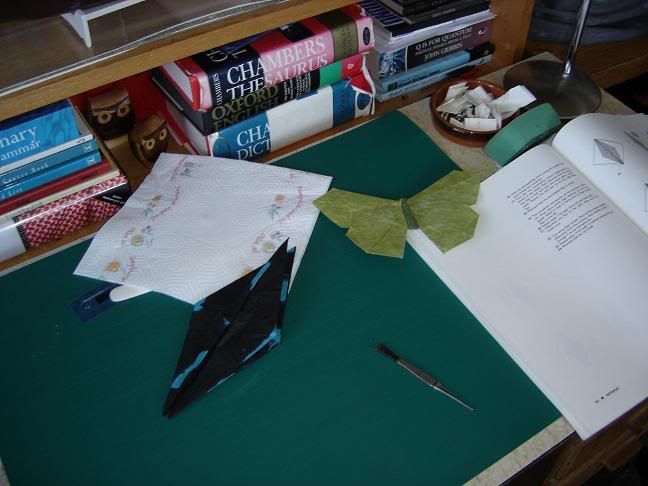
Veteran origami designer, Michael LaFosse, (whose butterfly you can see on the right of this photograph) also designed a very elegant Koi Carp, which he makes from white watercolour paper. He decorates the fish with blotches of red, black and orange paper. You can see an example of it here:

I wanted to do something similar but a bit more random, hence, before folding Peter Engel’s Octopus (pictured in its very early stages to the left of the butterfly), I glued some roughly torn pieces of turquoise khadi paper to a square of black, silk threads tissue. Some of this vivid blue will be visible in the tentacles and the body of the finished model. I hope that it will effectively represent either the play of light in the water, or the octopus’s natural skin pigmentation.

In the same vein, I am folding Jose Maria Chaquet Ulldemolinsversion of the iconic WWII fighter plane, The Spitfire, using a square of brown paper decorated with green strips, in an attempt to mimic the wartime camouflage.

I am also planning more ambitious, regimented collaging that will emulate, for example, the patterning on a giraffe’s hide. It’s an extension of back-coating, whereby two sheets of differently coloured paper are pasted together to produce a bi-coloured model. I think that it’s a much better way of adding colour and texture to a piece of origami than painting.